Category

Magazine

Echos Coiffure

By Magazine

Echos Coiffure – Facet by Bloomming

Belgian Hairdressing Magazine Showcases Facet in a Contemporary Salon Interior

Published in Echos Coiffure, November–December 2010

Belgian professional hairdressing magazine Echos Coiffure featured Facet, the modular room divider designed by Mireille Meijs and Bas van Leeuwen for Bloomming, in a report about the renovation of M&Team Hairdressers in Wuustwezel, Belgium.

The article focused on the salon’s transformation into a more efficient, organized, and calming environment. Within the redesigned interior, Facet was selected as a distinctive architectural element, separating the washing area from the styling space while maintaining openness and visual connection throughout the salon.

Facet

Facet is a modular room divider composed of individually rotatable geometric elements.

Each facet-shaped module can be adjusted independently, allowing the transparency of the room divider to be customized across its surface. This creates an ever-changing interplay of light, privacy, and pattern, giving the installation both a functional and sculptural presence.

The design combines spatial separation with visual openness, making it suitable for interiors where privacy is desired without sacrificing light or a sense of spaciousness.

Designed for Flexible Interiors

In the salon featured by Echos Coiffure, Facet was used to define different functional zones while preserving the bright, minimalist character of the interior.

The article notes that the individual polyester modules can be rotated independently, allowing the owner to transform the appearance of the room divider according to inspiration and the desired level of openness. This flexibility makes Facet particularly suitable for commercial environments where interior layouts and visual experiences play an important role.

A Focal Point in a Minimalist Space

The renovated salon was designed around simplicity, efficiency, and customer comfort.

Against a backdrop of white furniture and clean architectural lines, Facet introduced texture, depth, and visual interest. Rather than acting as a conventional partition, the room divider became a focal point within the space, demonstrating how functional elements can also contribute to the identity of an interior.

Product Information

Product: Facet
Designers: Mireille Meijs & Bas van Leeuwen
Brand: Bloomming
Category: Modular Room Divider
Material: High-quality synthetic material with stainless steel suspension system
Feature: Individually rotatable modules for adjustable transparency and privacy

Design Beyond Residential Spaces

The feature in Echos Coiffure illustrates Facet’s versatility beyond residential interiors.

Its ability to divide spaces without blocking light has made it a popular choice for hospitality, retail, office, and wellness environments. The project demonstrates how a room divider can contribute not only to functionality but also to the overall atmosphere and visual identity of a commercial interior.

Publication Details

Publication: Echos Coiffure
Country: Belgium
Issue: November–December 2010
Article: Le temps, c’est du luxe
Featured Product: Facet
Designers: Mireille Meijs & Bas van Leeuwen
Brand: Bloomming
Project Location: M&Team Hairdressers, Wuustwezel, Belgium


Original publication summary

“In a feature about the renovation of M&Team Hairdressers, Echos Coiffure highlighted Facet by Bloomming as a distinctive white room divider separating the shampoo area from the styling space. The article noted that the individual modules can be adjusted independently, allowing the partition to be transformed according to the desired level of openness.”
Trend

By Magazine

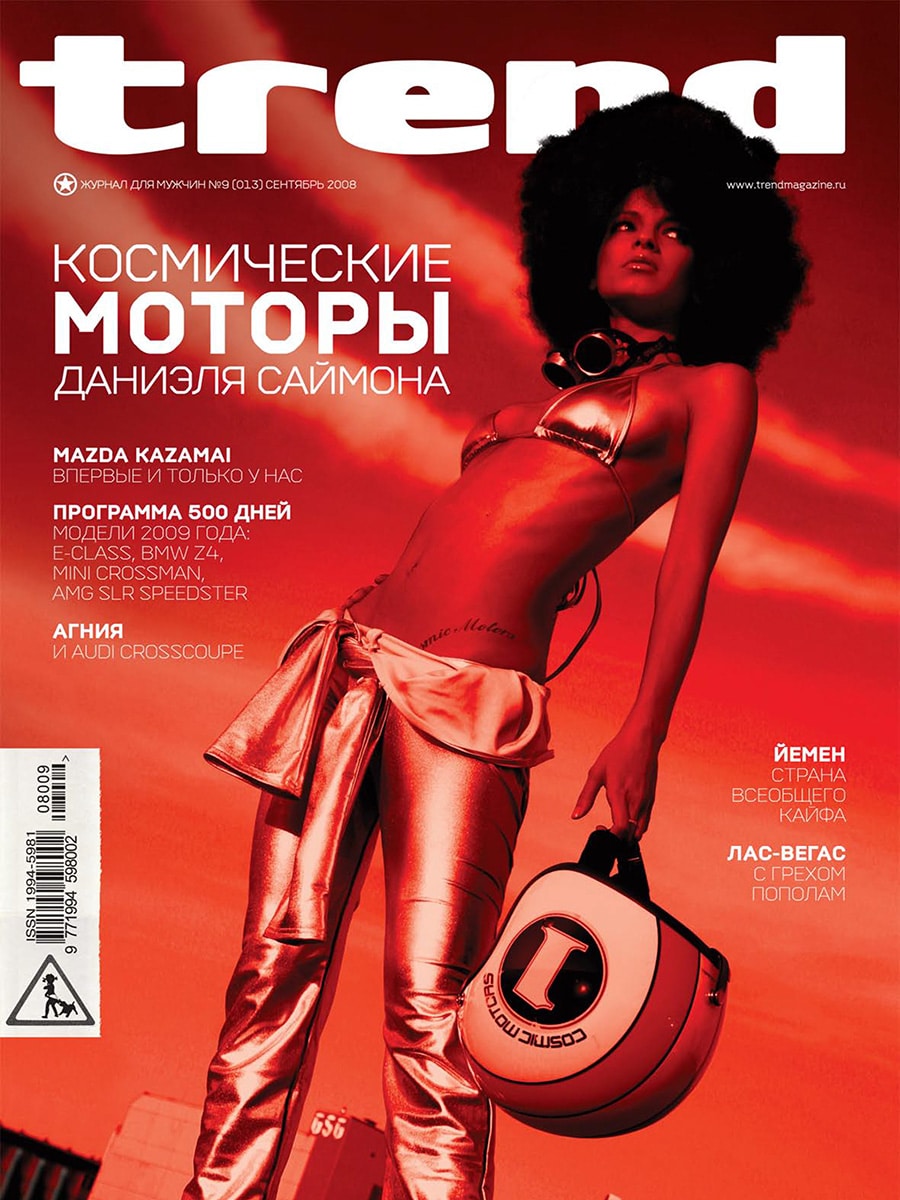
Clock Delay Featured in Trend Magazine Russia

Published in Trend Magazine, September 2008

Dutch designer Bas van Leeuwen and his sculptural clock Clock Delay were featured in the September 2008 edition of the Russian lifestyle magazine Trend.

The article presented Clock Delay as a response to modern society’s increasingly complicated relationship with time and technology. Rather than functioning as a conventional clock, the design transforms the measurement of time into a visible mechanical process.

Delayed Time

The Russian title of the article translates approximately as “Forced Delay” or “Delayed Time.”

According to the publication, clocks have long ceased to be simple instruments for measuring time. This observation inspired Bas van Leeuwen to create a clock that encourages people to slow down and engage with the mechanics behind the passage of time.

The article describes Clock Delay as a challenge to contemporary “single-use culture”—a world filled with disposable products that require little attention and provide little understanding of how they work.

Revealing the Mechanism

Unlike traditional clocks that conceal their mechanics behind a dial, Clock Delay exposes the entire process of timekeeping.

The design consists of three rotating wheels representing:

  • Hours
  • Minutes
  • Seconds

Rather than reading the time from hands or a digital display, users observe where the three indicators align. The clock turns the act of telling time into a small puzzle that requires attention and participation.

As the article explains, learning to read the time on Clock Delay requires temporarily stepping away from the automated routines of everyday life.

A Tribute to Technology

The publication notes that many people rarely repair or examine the products they use every day. As a result, appreciation for technology and engineering is gradually disappearing.

Clock Delay was designed to counter this trend by celebrating the beauty of mechanics. Its exposed gears, rotating number wheels and visible construction encourage users to rediscover the fascination of how things work.

The design reflects Bas van Leeuwen’s interest in combining technology, interaction and visual storytelling within everyday objects.

Design and Construction

The article describes Clock Delay as a fully functional clock constructed from:

  • Stainless steel
  • Aluminum

Dimensions:

  • 35 × 35 × 48 cm

The publication notes that the unusual appearance ensures the object will not go unnoticed in any interior.

International Recognition

Clock Delay attracted attention beyond the Netherlands and was featured in several international publications. Its combination of engineering, sculpture and conceptual thinking positioned it as a distinctive example of contemporary Dutch design.

About Clock Delay

Designer: Bas van Leeuwen
Studio: Studio Bloomm
Product: Clock Delay
Materials: Stainless steel and aluminum
Dimensions: 35 × 35 × 48 cm
Year: 2008

Publication Details

Publication: Trend Magazine (Russia)
Issue: September 2008
Featured designer: Bas van Leeuwen
Featured product: Clock Delay
Topics: Product design, clocks, engineering, contemporary Dutch design, kinetic objects

Bloomming-RAF-1

RAF

By Magazine

Raf Ürün Dergisi – January 2012, Issue 36

Raf Ürün Dergisi (Raf Product Magazine) is a Turkish design and product magazine published by Arkitera Press, one of Turkey’s leading architecture and design media organizations. Arkitera is widely known in the Turkish professional design community through its online platform and print publications, serving architects, interior designers, product designers, and construction industry professionals across Turkey. Raf focuses specifically on interior products, materials, and design solutions, making it a specification-oriented resource for the Turkish architecture and interior design market. Issue 36 was published in January 2012 and is distributed free of charge to professionals within the sector.

3form Facet – Perde ve Bölücü Panel Uygulamaları

Page 50 of the issue features a full-page advertorial for 3form presenting Facet under the heading “3form Facet – Perde ve Bölücü Panel Uygulamaları” (3form Facet – Curtain and Divider Panel Applications). The feature is presented in the kibrD section of the magazine, which covers product and material introductions for design professionals. The page is supported by four installation photographs showing Facet deployed across a range of interior environments, including a spa or wellness setting, a lounge with exposed brick walls, a restaurant interior, and a close-up detail view of the individual faceted modules.

The editorial text describes Facet as a fully modular system with unlimited alternatives for curtain and space-dividing applications. It explains that the system was designed to create interactive patterns, with each of its three-dimensional elements capable of rotating 360 degrees to generate compositions of light and shadow. The product is characterized as fully recyclable, highly durable, and manufactured from high-quality sustainable materials.

Technical Specifications Presented

The feature presents Facet’s technical properties in structured detail for the benefit of specifying professionals:

The system consists of five components and is described as smart, light, simple, and easy to install. It offers unlimited configuration options and is interactive, sustainable, UV-resistant, and antistatic. Modular grid units can be extended vertically and horizontally to achieve any desired width and height. Height can be extended in 195 mm increments up to 2,865 mm. Width can be extended without limit in 340 mm increments. The standard color is white (RAL 9003), with custom colors available on request. Weight is 4.5 kg per square meter. The material carries a UL94 V-0 fire-retardant rating and is manufactured from PC/ABS. On sustainability, the feature notes that the polycarbonate, nylon, and aluminum components can be separated and individually recycled, and that each part can be removed from the system and recycled independently. The polycarbonate used can be fully reprocessed for new product manufacturing.

Publication Context

The appearance of Facet in Raf Ürün Dergisi reflects the product’s growing reach into the Turkish architecture and interior design market through 3form’s distribution and specification network. Turkey’s active construction and hospitality sectors made it a significant market for architectural interior products, and Arkitera’s professional readership — architects, interior designers, and product specifiers — represented the precise audience for a product of Facet’s type and scale. The January 2012 issue coincided with a period of strong activity in the Turkish construction market, making professional product publications of this kind an important channel for reaching decision-makers at the specification stage of projects.

Publication Details

Publication: Raf Ürün Dergisi (Raf Product Magazine)
Publisher: Arkitera Press
Issue: 36
Date: January 2012
Page: 50
Section: kibrD
Feature title: 3form Facet – Perde ve Bölücü Panel Uygulamaları
Product featured: Facet room divider / curtain panel system
Designers: Bas van Leeuwen & Mireille Meijs
Company: Bloomming
Manufacturer: 3form
Category: Turkish architecture and interior design product magazine

Why this feature mattered

Raf Ürün Dergisi’s professional readership and its focus on product specification made it a valuable platform for introducing Facet to the Turkish design market. Arkitera’s strong position within the Turkish architecture community meant that a feature in Raf carried genuine credibility with the architects and interior designers most likely to specify a product like Facet for commercial, hospitality, or residential projects. The detailed technical specification content — dimensions, weights, fire ratings, sustainability credentials, and color options — presented the product in exactly the format needed by professionals at the point of specification, reinforcing Facet’s suitability for demanding professional and commercial applications in the Turkish market.

Bloomming-Dlux-1

D Lux

By Magazine

D*LUX Magazine – Lightfacet by Bloomming

D*LUX Magazine is an international publication focused on the intersection of light and architecture. Titled “Luce per l’Architettura Globale” (Light for Global Architecture), the magazine explores innovative lighting design, artistic installations, and the functional application of light in modern spaces. Distributed globally, it serves as a high-end reference for architects, interior designers, and light artists, showcasing products and projects that redefine how light interacts with the built environment.

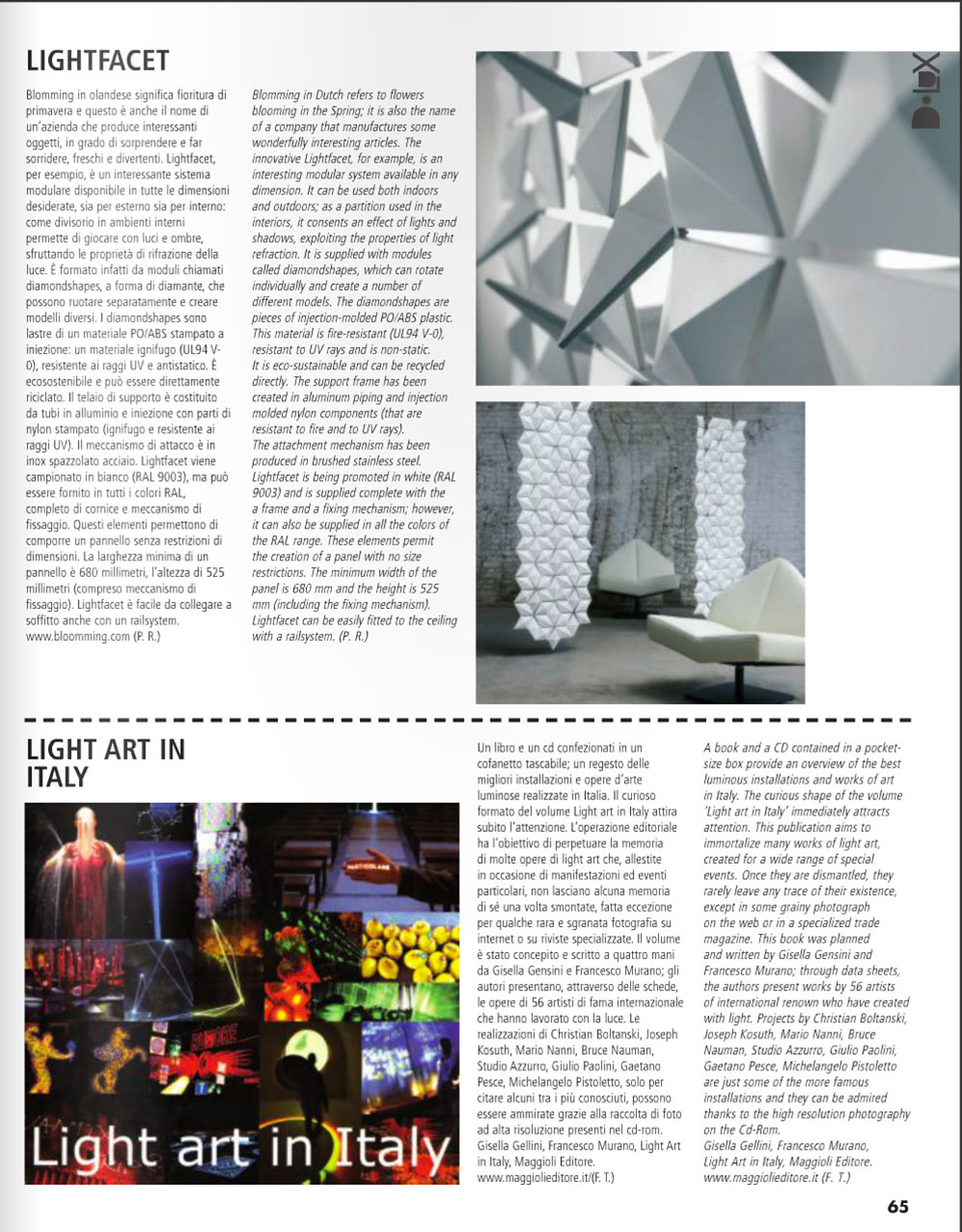
Lightfacet by Bloomming in D*LUX 7

Within issue number 7 of D*LUX Magazine, the Lightfacet system by Bloomming is featured in a dedicated product profile on page 65. The article highlights Lightfacet as an “interesting modular system” available in customizable dimensions for both indoor and outdoor use.

The feature emphasizes the technical and aesthetic versatility of the product. Constructed from injection-molded PO/ABS “diamond shapes,” Lightfacet allows for a dynamic play of light and shadow by exploiting the properties of light refraction. The publication details the product’s sustainability—being eco-friendly and recyclable—and its practical application via a ceiling rail system. The visual presentation includes a close-up of the white (RAL 9003) modular surface and a lifestyle shot featuring Lightfacet as a free-hanging room divider in a contemporary seating area, illustrating its role as a functional architectural “partition.”

“Light Art in Italy” Feature

The same page also highlights the publication Light Art in Italy, a book and CD-ROM project by Gisella Gellini and Francesco Murano. This editorial project aims to “immortalize many works of light art” created for special events that are often dismantled shortly after their exhibition. By featuring this alongside Lightfacet, the magazine draws a clear connection between industrial design products and the broader cultural movement of light art, citing renowned artists like Christian Boltanski, Bruce Nauman, and Gaetano Pesce.

The Role of D*LUX Magazine

DLUX occupies a niche as a bridge between technical architectural lighting and artistic expression. Because the magazine focuses on “Global Architecture,” inclusion in its pages provides international visibility within a specialized community of experts. Unlike consumer-facing decor magazines, D LUX targets professionals who specify products for large-scale architectural projects, galleries, and high-end residential interiors.

Publication Details

  • Publication: D*LUX Magazine (Issue 7)
  • Title: Luce per l’Architettura Globale
  • Page: 65
  • Product Featured: Lightfacet
  • Company: Bloomming
  • Associated Feature: “Light Art in Italy” by Maggioli Editore
  • Category: International Architecture and Lighting Design Magazine

Why this feature mattered

The inclusion in D*LUX Magazine validated Lightfacet not just as a piece of furniture, but as an architectural tool for light management. Specifically, the mention of its fire-resistant (UL94 V-0) and UV-resistant properties in a professional architectural journal positioned the product as a viable solution for public and commercial spaces. By sharing the page with a prestigious catalog of 56 international light artists, Bloomming’s design was framed within the context of high-level lighting research and Italian design excellence, reinforcing its reputation for innovation and quality.