Category

Magazine

Prestige

By Magazine

Prestige 164 Magazine (China) – Clock Delay by Bloomming

Dutch Design Featured in Chinese Lifestyle Magazine

Published in Prestige 164, August 2009

Chinese lifestyle magazine Prestige 164 featured Clock Delay, the experimental clock designed by Bas van Leeuwen for Dutch design studio Bloomming, in its “What’s Up” design section.

The publication highlighted Clock Delay as an unusual interpretation of timekeeping that transforms the familiar clock into a kinetic mechanical sculpture.

Clock Delay

Unlike conventional clocks that display time through hands on a flat dial, Clock Delay reveals the underlying mechanics of time itself.

The design consists of three rotating gears representing seconds, minutes, and hours. Rather than hiding the mechanism behind a clock face, the movement becomes the central visual element. Time is read at the point where the three rotating wheels align.

Constructed from stainless steel and aluminium, Clock Delay combines engineering, movement and visual poetry into a single object.

Featured in the “What’s Up” Design Section

Prestige 164 presented Clock Delay alongside a selection of international design innovations and lifestyle discoveries from around the world.

The magazine described the clock as a contemporary object that challenges conventional expectations of how a clock should look and function. By exposing its internal workings, Clock Delay invites users to slow down and engage with the passage of time in a more thoughtful way.

Design Philosophy

Clock Delay was created from the observation that modern products increasingly hide their workings behind smooth surfaces and digital interfaces.

By making the mechanism visible and essential to the reading of time, the design celebrates craftsmanship, engineering and curiosity. The clock encourages viewers to look beyond pure functionality and appreciate the beauty of mechanical movement.

Rather than offering an instant reading, Clock Delay asks for a moment of attention. The process of discovering the time becomes part of the experience.

Product Information

Product: Clock Delay
Designer: Bas van Leeuwen
Studio: Bloomming
Materials: Stainless steel and aluminium
Dimensions: Approximately 35 × 35 × 48 cm
Type: Mechanical-inspired kinetic clock

International Recognition

The appearance in Prestige 164 contributed to the growing international recognition of Clock Delay. During this period the design was featured in publications across Europe, North America and Asia, attracting attention for its unconventional approach to one of the most familiar household objects.

Clock Delay became one of the early projects that helped establish Bloomming’s reputation for creating products that combine conceptual thinking with playful interaction and strong visual identity.

Publication Details

Publication: Prestige 164
Country: China
Issue: August 2009
Section: What’s Up / Design
Featured Product: Clock Delay
Designer: Bas van Leeuwen
Studio: Bloomming


Image caption from the original publication

“Clock Delay by Bloomming reimagines the traditional clock as a visible mechanical construction. Three rotating gears representing hours, minutes and seconds intersect to reveal the time, turning a functional object into a kinetic sculpture.”
BeauMonde

By Magazine

Beau Monde – Facet by Bloomming

Dutch Lifestyle Magazine Features Facet in a Rising Culinary Destination

Published in Beau Monde, January 2011

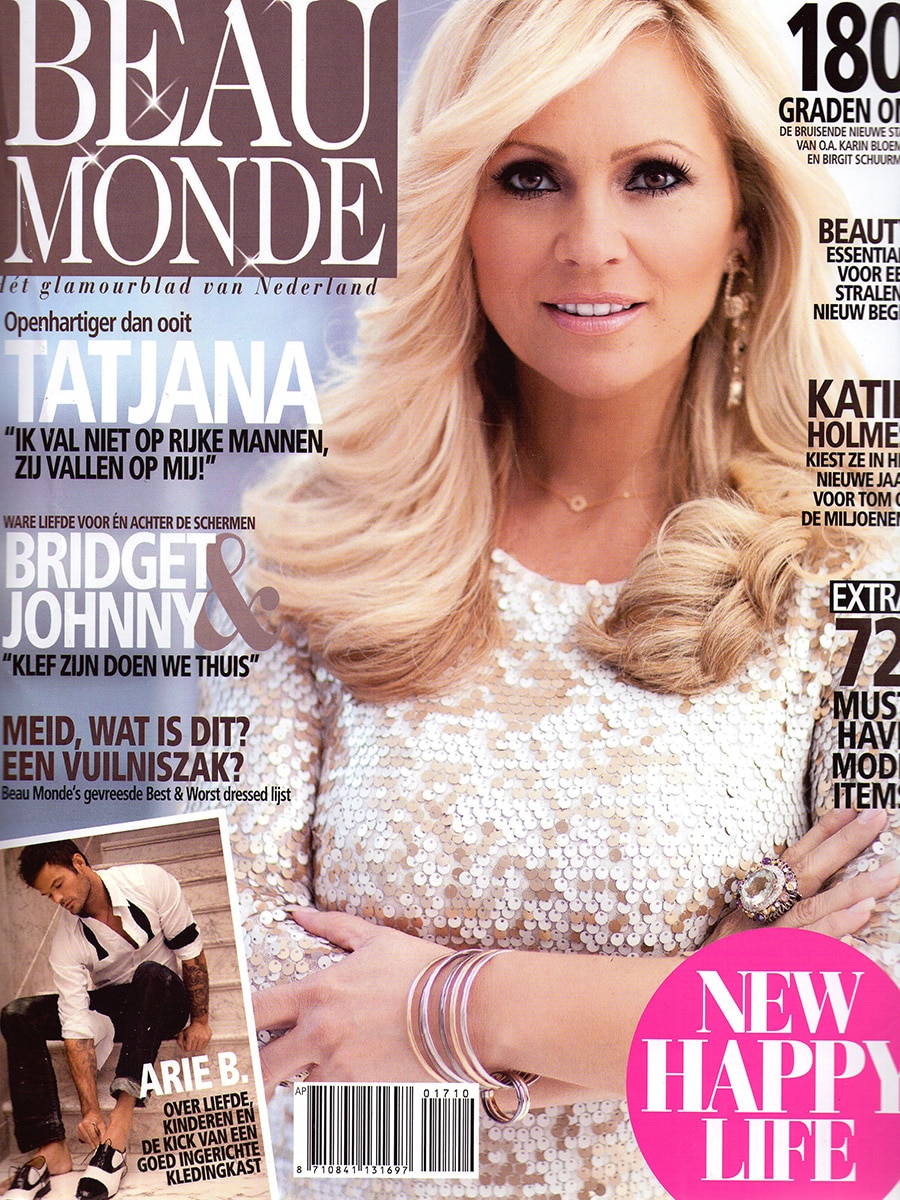
Dutch lifestyle magazine Beau Monde featured Facet, the modular room divider designed by Mireille Meijs and Bas van Leeuwen for Bloomming, in its culinary guide to the most promising restaurant destinations of 2011.

The publication highlighted Restaurant Le Défi in Sprang-Capelle as one of the Netherlands’ rising gastronomic stars and showcased Facet as an integral part of the restaurant’s interior. The sculptural divider appears in the dining room, where it subtly separates spaces while preserving openness and light.

Facet

Facet is a modular room divider composed of individually rotatable geometric elements.

Each module can be adjusted independently, allowing users to create unique patterns of transparency, light and privacy. The result is a dynamic architectural surface that continuously changes appearance depending on the viewing angle and the position of the individual facets.

Unlike traditional partitions, Facet creates separation without completely closing off a space, making it particularly suited to hospitality environments.

Creating Atmosphere Through Space

Restaurants rely on carefully balanced atmospheres. Guests often appreciate a sense of intimacy while still feeling connected to the surrounding environment.

Facet addresses this challenge by dividing spaces visually rather than physically. The semi-transparent structure filters views, softens sightlines and creates distinct zones within larger interiors while maintaining an open and welcoming character.

Design for Hospitality Interiors

The installation at Restaurant Le Défi demonstrates how Facet can contribute to a refined dining experience.

Its geometric pattern introduces visual interest while the adjustable modules allow the degree of openness to be tailored to the space. The divider functions simultaneously as an architectural element, a decorative feature and a practical tool for defining areas within the restaurant.

Product Information

Product: Facet
Designers: Mireille Meijs & Bas van Leeuwen
Brand: Bloomming
Category: Modular Room Divider
Material: High-quality synthetic material with stainless steel suspension system
Feature: Individually rotatable modules for adjustable transparency and privacy

Design Meets Fine Dining

By appearing in one of the Netherlands’ leading lifestyle magazines, Facet reached an audience interested not only in design, but also in luxury experiences, hospitality and contemporary living.

The feature demonstrated how thoughtful interior design can enhance the atmosphere of a restaurant and contribute to the overall guest experience without compromising openness or natural light.

Publication Details

Publication: Beau Monde
Country: The Netherlands
Issue: January 2011
Section: Culinair
Featured Product: Facet
Designers: Mireille Meijs & Bas van Leeuwen
Brand: Bloomming
Location Featured: Restaurant Le Défi, Sprang-Capelle


Original publication summary

“Beau Monde featured Restaurant Le Défi as one of the Netherlands’ rising culinary destinations. The accompanying interior photograph showcased Facet by Bloomming, a modular room divider that creates elegant separation within the dining space while maintaining openness, light and visual connection.”

Bloomming-RAF-1

RAF

By Magazine

Raf Ürün Dergisi – January 2012, Issue 36

Raf Ürün Dergisi (Raf Product Magazine) is a Turkish design and product magazine published by Arkitera Press, one of Turkey’s leading architecture and design media organisations. Arkitera is widely known in the Turkish professional design community through its online platform and print publications, serving architects, interior designers, product designers and construction industry professionals across Turkey. Raf focuses specifically on interior products, materials and design solutions, making it a specification-oriented resource for the Turkish architecture and interior design market. Issue 36 was published in January 2012 and is distributed free of charge to professionals within the sector.

3form Facet – Curtain and Divider Panel Applications

Page 50 of the issue features a full-page advertorial for 3form presenting Facet under the heading “3form Facet – Curtain and Divider Panel Applications”. The feature is presented in the kibrD section of the magazine, which covers product and material introductions for design professionals. The page is supported by four installation photographs showing Facet deployed across a range of interior environments, including a spa or wellness setting, a lounge with exposed brick walls, a restaurant interior and a close-up detail view of the individual faceted modules.

The editorial text describes Facet as a fully modular system with unlimited alternatives for curtain and space-dividing applications. It explains that the system was designed to create interactive patterns, with each of its three-dimensional elements capable of rotating 360 degrees to generate compositions of light and shadow. The product is characterised as fully recyclable, highly durable and manufactured from high-quality sustainable materials.

Technical Specifications Presented

The feature presents Facet’s technical properties in structured detail for the benefit of specifying professionals:

The system consists of five components and is described as smart, light, simple and easy to install. It offers unlimited configuration options and is interactive, sustainable, UV-resistant and antistatic. Modular grid units can be extended vertically and horizontally to achieve any desired width and height. Height can be extended in 195 mm increments up to 2,865 mm. Width can be extended without limit in 340 mm increments. The standard colour is white (RAL 9003), with custom colours available on request. Weight is 4.5 kg per square metre. The material carries a UL94 V-0 fire-retardant rating and is manufactured from PC/ABS. On sustainability, the feature notes that the polycarbonate, nylon and aluminium components can be separated and individually recycled, and that each part can be removed from the system and recycled independently. The polycarbonate used can be fully reprocessed for new product manufacturing.

Publication Context

The appearance of Facet in Raf Ürün Dergisi reflects the product’s growing reach into the Turkish architecture and interior design market through 3form’s distribution and specification network. Turkey’s active construction and hospitality sectors made it a significant market for architectural interior products, and Arkitera’s professional readership — architects, interior designers and product specifiers — represented the precise audience for a product of Facet’s type and scale. The January 2012 issue coincided with a period of strong activity in the Turkish construction market, making professional product publications of this kind an important channel for reaching decision-makers at the specification stage of projects.

Publication Details

Publication: Raf Ürün Dergisi (Raf Product Magazine)
Publisher: Arkitera Press
Issue: 36
Date: January 2012
Page: 50
Section: kibrD
Feature title: 3form Facet – Perde ve Bölücü Panel Uygulamaları
Product featured: Facet room divider / curtain panel system
Designers: Bas van Leeuwen & Mireille Meijs
Company: Bloomming
Manufacturer: 3form
Category: Turkish architecture and interior design product magazine

Why this feature mattered

Raf Ürün Dergisi’s professional readership and its focus on product specification made it a valuable platform for introducing Facet to the Turkish design market. Arkitera’s strong position within the Turkish architecture community meant that a feature in Raf carried genuine credibility with the architects and interior designers most likely to specify a product like Facet for commercial, hospitality or residential projects. The detailed technical specification content — dimensions, weights, fire ratings, sustainability credentials and colour options — presented the product in exactly the format needed by professionals at the point of specification, reinforcing Facet’s suitability for demanding professional and commercial applications in the Turkish market.

Bloomming-Dlux-1

D Lux

By Magazine

D*LUX Magazine – Lightfacet by Bloomming

D*LUX Magazine is an international publication focused on the intersection of light and architecture. Titled “Luce per l’Architettura Globale” (Light for Global Architecture), the magazine explores innovative lighting design, artistic installations, and the functional application of light in modern spaces. Distributed globally, it serves as a high-end reference for architects, interior designers, and light artists, showcasing products and projects that redefine how light interacts with the built environment.

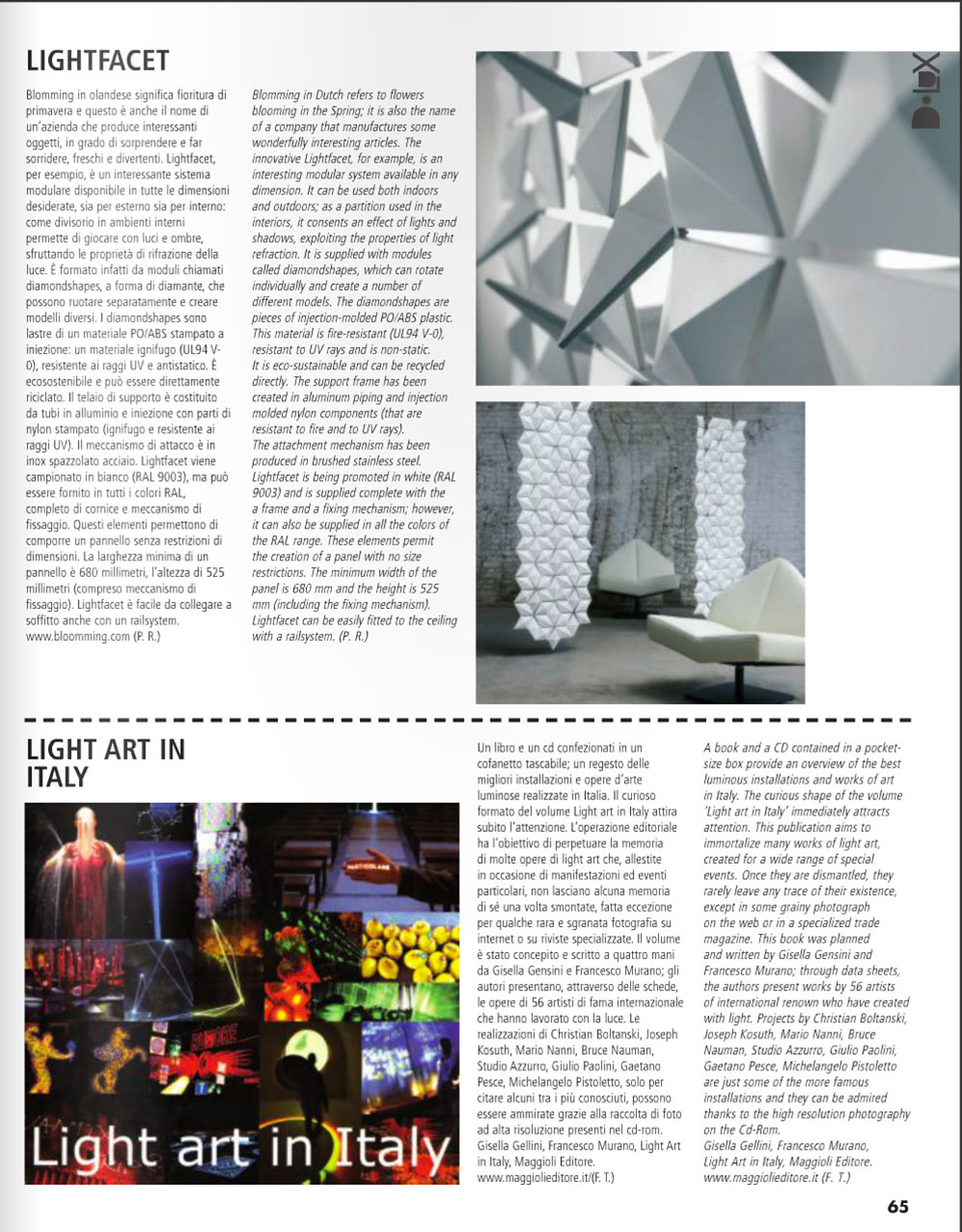
Lightfacet by Bloomming in D*LUX 7

Within issue number 7 of D*LUX Magazine, the Lightfacet system by Bloomming is featured in a dedicated product profile on page 65. The article highlights Lightfacet as an “interesting modular system” available in customisable dimensions for both indoor and outdoor use.

The feature emphasises the technical and aesthetic versatility of the product. Constructed from injection-moulded PO/ABS “diamond shapes,” Lightfacet allows for a dynamic play of lights and shadows by exploiting the properties of light refraction. The publication details the product’s sustainability—being eco-friendly and recyclable—and its practical application via a ceiling rail system. The visual presentation includes a close-up of the white (RAL 9003) modular surface and a lifestyle shot featuring Lightfacet as a free-hanging room divider in a contemporary seating area, illustrating its role as a functional architectural “partition.”

“Light Art in Italy” Feature

The same page also highlights the publication Light Art in Italy, a book and CD-ROM project by Gisella Gellini and Francesco Murano. This editorial project aims to “immortalise many works of light art” created for special events that are often dismantled shortly after their exhibition. By featuring this alongside Lightfacet, the magazine draws a clear connection between industrial design products and the broader cultural movement of light art, citing renowned artists like Christian Boltanski, Bruce Nauman, and Gaetano Pesce.

The Role of D*LUX Magazine

DLUX occupies a niche as a bridge between technical architectural lighting and artistic expression. Because the magazine focuses on “Global Architecture,” inclusion in its pages provides international visibility within a specialised community of experts. Unlike consumer-facing décor magazines, D LUX targets professionals who specify products for large-scale architectural projects, galleries, and high-end residential interiors.

Publication Details

  • Publication: D*LUX Magazine (Issue 7)
  • Title: Luce per l’Architettura Globale
  • Page: 65
  • Product Featured: Lightfacet
  • Company: Bloomming
  • Associated Feature: “Light Art in Italy” by Maggioli Editore
  • Category: International Architecture and Lighting Design Magazine

Why this feature mattered

The inclusion in D*LUX Magazine validated Lightfacet not just as a piece of furniture, but as an architectural tool for light management. Specifically, the mention of its fire-resistant (UL94 V-0) and UV-resistant properties in a professional architectural journal positioned the product as a viable solution for public and commercial spaces. By sharing the page with a prestigious catalogue of 56 international light artists, Bloomming’s design was framed within the context of high-level lighting research and Italian design excellence, reinforcing its reputation for innovation and quality.